
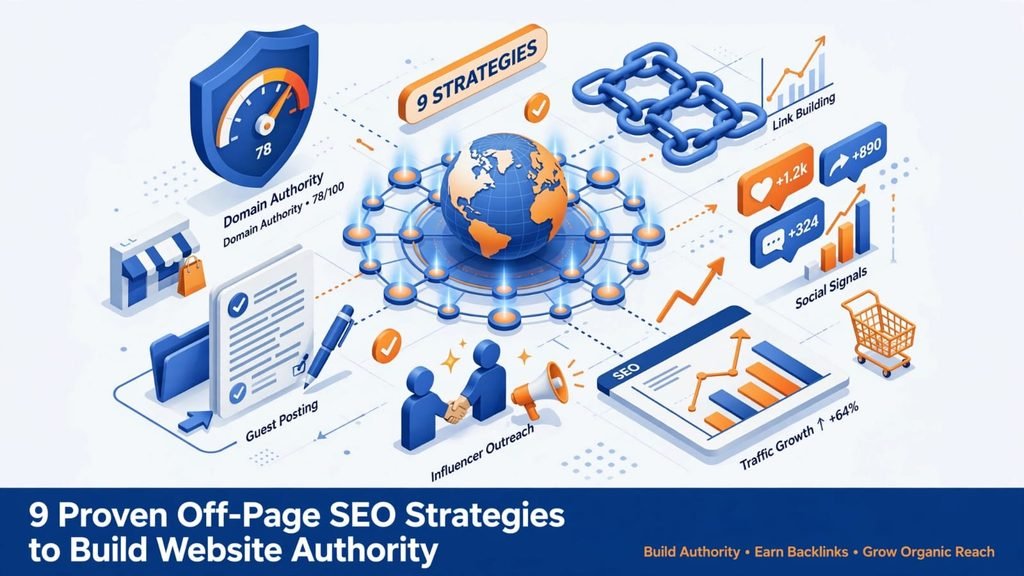
Off-page SEO strategies are supposed to make your site look trustworthy to Google. When I started, I read that as “get as many backlinks as possible.” So I did. My backlink count went up, but my visibility barely moved.
It’s an experience that altered my approach to work. In this guide, I’ll tell you the 9 off page SEO tips that I believe now, what I did wrong and how I do it for free.
Table of Contents
What are Off Page SEO Strategies?
Off page SEO refers to any attempt to build your website’s reputation that you make outside of your website. The largest is the backlink part. Brand mentions, relationships and community presence are also factors.
The aim is to achieve website authority, which is trust that is given to your website by other reliable sources. Authority is not an official Google score. It can be estimated using tools such as Ahrefs and Moz, but use their own metrics as a ballpark figure.
There’s one thing all good off page seo practices have in common: gaining the attention of the right people at the right place.
Why Relevance Beats Backlink Count
Early on, I went after easy links. I used low-quality directories, link-submission sites, and unrelated websites that accepted anything. My backlink count rose, and it felt like progress.
But my visibility didn’t improve. Those links sent almost no referral traffic, and they had nothing to do with my topic. That’s when I rethought my approach.
Here’s how the two types of links compare:
| Criteria | Relevant, trusted link | Random, low-quality link |
| Source | Niche site with editorial standards | Directory or link-submission site |
| Referral traffic | Some real visitors | Almost none |
| Effort | Higher | Low |
| Long-term value | Builds trust over time | Little value, some risk |
9 Proven Off-Page SEO Strategies
1. Create Linkable Assets
Nobody links to thin content when implementing off-page SEO strategies. Start with something worth citing, like a practical guide, a checklist.
2. Write Guest Posts for Relevant Sites
I once pitched a guest post to a digital marketing and SEO website. First, I studied its audience and past topics. Then I sent the owner a short, personalized pitch for an article on SEO strategies for small businesses.
The pitch was accepted, and I added one natural link back to my site. I didn’t see a dramatic ranking jump. I did get a quality backlink, some referral traffic, and more confidence in outreach. That’s a realistic outcome.
3. Link brand in unlinked references
Sometimes, people speak about your brand without tying it to you. Search Internet for your brand name or website. This can be accelerated with the use of SEO and search operators.
Then send a brief, courteous message to them. It’s like this:
Thank you for having my site included in your article. If you believe it would be of interest to your readers, would you be willing to include a link that would help your readers?
This is one of the most effective off-page SEO strategies, far better than link-building emails that don’t have a personal touch.
4. Do Personalized Outreach
List relevant blogs, local businesses, industry sites, and communities. Choose relevance over high domain numbers. Then explain how your content helps their audience instead of opening with a link request. Generic templates usually get ignored.
5. Build True Connections
Connect with the people who produce content, marketing or entrepreneurs in your niche. Comment and give respectful criticism where needed. Connections result in recognition and collaborations. This may not be the fastest way but it’s definitely the most effective.
6. Learn how to approach Communities the Right Way
Your reputation can be built up in forums, social groups and professional websites. Don’t leave things everywhere, answer the questions correctly. If it is a good answer, include a link, otherwise don’t. If not, skip it.
7. Broken Link Building
Check outbound links on relevant sites for broken links as part of your off-page SEO strategies. If the content is a true replacement, notify the owner. You’re solving a problem for them and they feel like they are getting something out of you, rather than you pushing them to do something.
8. Build Your Site for SEO
Share new content where your audience already is, like on LinkedIn, niche communities, etc. and newsletters. If you want to find a way to look better in search engines, you’ll need to do more than simply increase your social shares. But they put your work before people who can connect to it.
9. Track Results and Cut What Doesn’t Work
Monitor new backlinks, referral traffic, rankings, and mentions. Google Search Console shows who links to your site, and tools like Ahrefs add more detail. Do more of what works. Drop low-quality opportunities fast.
Off-Page SEO Techniques to Avoid
There are shortcuts which cost more than what they give. Skip these:
- Poorly done directories: They do not provide much editorial oversight and hardly any traffic.
- Link submission websites: Links are easy, but have little value.
- Scalable paid or exchanged links: Google’s spam policies consider link schemes spam.
- Thread promotion: This is a sign of an unproductive forum.
How to Build Website Authority With No Budget
You don’t need money to start. You need consistency. Follow these steps:
- Publish one page that is really helpful and answers some questions.
- Add all relevant websites in your industry to your list.
- Make an offer to write something interesting and helpful about yourself.
- Check unlinked brand mentions and make requests nicely.
- Watch what is working and do it again.
Don’t try to build 100 backlinks. Aim to earn your first 5–10 relevant, trustworthy links. If you also want a strong base, start with a technical check first (see my guide on SEO audits).
FAQs
How long do off-page SEO strategies take to work?
Usually months, not weeks. Results vary by niche, competition, and content quality.
Do I need a budget to build website authority?
No. Useful content, outreach, and relationships cost time, not money.
Are all directory links bad?
Not all. But low-quality directories with no editorial review rarely help, so choose relevant, trusted ones.
How many backlinks do I need?
There’s no magic number. A few relevant links from trusted sites beat hundreds of random ones.
Conclusion
Building website authority through off-page SEO is not about collecting as many backlinks as possible. From my learning and hands-on experience with SEO, I’ve found that relevance, trust, and consistency matter much more than chasing numbers.
Strategies such as genuine outreach, guest posting, unlinked brand mentions, relationship building, and creating useful content can gradually strengthen your website’s authority. The key is to focus on earning links that make sense for your audience rather than trying to get links from anywhere.
As a freelance digital marketer in Kochi, I believe good SEO takes patience. There may not be an immediate jump in rankings, but consistently creating valuable content, building genuine connections, and improving your website over time can create a stronger foundation for long-term organic growth.
Start with a few relevant opportunities, learn from what works, and keep improving your off-page SEO strategies.