
Table of Contents
Most websites don’t have a traffic problem first. They have a clarity problem. Google can’t tell what the page is about, and visitors can’t tell either.
These on-page SEO techniques solve this problem. I implement them for clients as a freelance digital marketer, and will tell about successful and unsuccessful implementations and mistakes I face regularly.
So, if you want to learn how to optimize your website for search engines on the page level without any tricks, read on.
What are On-Page SEO Techniques?
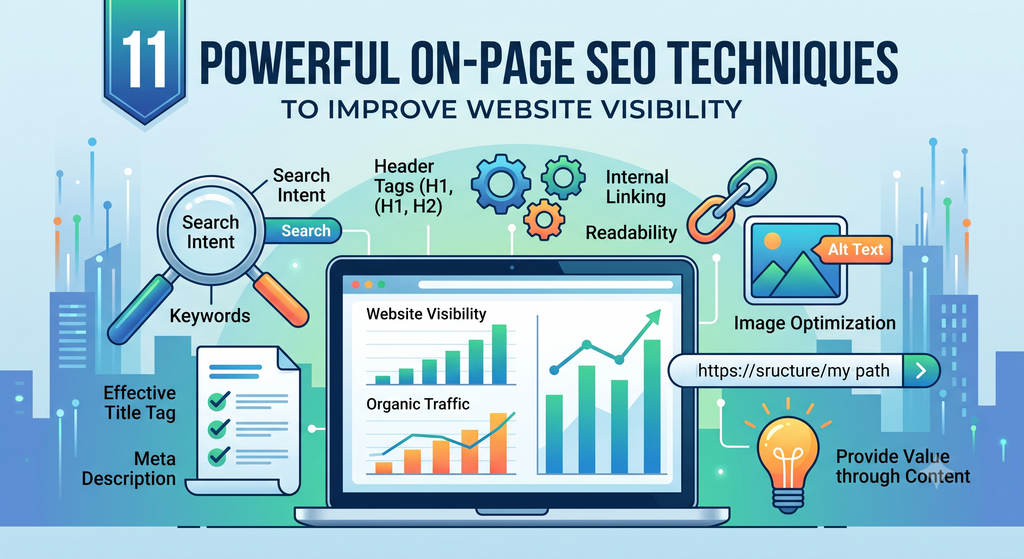
On-page SEO techniques are changes made directly on the web page in order to let search engines understand its content and value. They include content optimization, title tags, headings, links, images, URLs.
You are fully in control of them. This makes on-page SEO the optimal entry point for novices.
11 On-Page SEO Techniques That Work
1. Search Intent First
It is the key technique that should be implemented before everything else. Ask yourself what does the searcher need – to inform, compare or hire?
Your web page may be perfectly written but won’t bring any results if it answers another question. Even Google recommends making informative content (Google Search Central).
2. Pick the Right Primary Keyword
Wrong keyword targeting is the most common problem I see. One client had a service page aimed at the broad term “digital marketing.” It was far too competitive, and it didn’t match what the page offered.
We changed the target to “digital marketing services for small businesses” and rewrote the title, headings, and content around that intent. The page then attracted more relevant organic traffic and leads.
3. Create an Effective Title Tag
The number one thing I recommend for a beginner is to fix the title tag. The title tag describes the page to Google and visitors.
Include the keyword naturally.
Keep the title tag under 60 characters.
Create a title that people will click.
4. Write a Meta Description That Will Drive Clickthroughs
While meta description tags do not improve rankings they do affect how many times a searcher clicks your listing. Try to keep the description between 150 and 160 characters include the benefit and add the keyword once.
5. Use one H1 Tag with Suitable Sub-headings
The H1 tag must communicate the contents of the page to visitors in language. Suitable headings, for sections of the page can be used (H2 and H3). Suitable titles and headings will make scanning easy for both visitors and search engines.
6. Provide Value through Content
Pages with thin content don’t have much chance of ranking. In the case of one client, his services page contained very little value-filled information. I gave answers to the actual queries of the buyer and saw that the page started ranking for suitable keywords.
Think to yourself that would a visitor who only read the contents of this page leave happy?
Looking for a second set of eyes on your pages? A brief audit usually uncovers the issues with titles and keywords first.
7. Use Keywords Naturally
I think keyword density is the most overrated on-page SEO technique. Chasing an exact percentage makes writing stiff. Cover the topic fully, use related phrases where they fit, and move on.
Use your keyword in these places:
- The H1 and title tag
- The first 100 words
- At least one H2
- The conclusion
8. Internal links are smart
Internal links are helpful for both Google and users in order to understand which page is important and where users should go next. Use anchor text in the link and don’t just write “Click here”.
9. Image optimization
Reduce the size of images to make your pages loading faster. Create descriptive alternative texts and use keywords only when it is necessary.
10. Make your URLs readable and understandable
Compare /on-page-seo-techniques and /p?id=48392. The first URL shows clearly what kind of information you can find there. Keep slugs short, lowercase and hyphenated.
11. Fix Readability and Technical Basics
Short paragraphs, simple words, and clear formatting keep people reading. Also check mobile display and page speed. Google’s SEO Starter Guide is a solid reference.
My On-Page SEO Audit Process
Here is the process I follow on every page:
- Check the target keyword and search intent.
- Review the title tag and meta description.
- Check headings, content quality, and keyword usage.
- Review internal links, images, and URLs.
- Look for technical issues.
- Study competitors and note the gaps.
- Make the changes.
- Monitor rankings, traffic, and clicks.
Common On-Page SEO Mistakes
| Mistake | Better Approach |
| Targeting a keyword that’s too broad | Choose a specific phrase that matches the page |
| Ignoring search intent | Study what the top results actually answer |
| Stuffing keywords | Write naturally and cover the topic fully |
| Weak title tags | Be clear, specific, and include the keyword |
| Thin content | Answer the questions buyers actually ask |
Where On-Page SEO Has Limits
On-page SEO won’t fix everything. Results depend on competition, site authority, and how often Google recrawls your pages. Changes can take weeks to show up, so measure over time.
FAQs
How long does it take for on-page SEO changes to start showing results?
It usually takes a weeks. The amount of competition in the niche and the authority of the website both affect how quickly changes take effect.
What is the important on-page SEO technique?
The important method is making sure the content matches the search intent. All other on-page optimizations support this goal.
Does keyword density matter anymore?
No it does not. There is no need to focus on a number. What matters most is how relevant and useful the content is to the user.
What should beginners fix first when working on on-page SEO?
Beginners should start with the title tag and the H1 heading. These elements must clearly describe what the page is, about.
Conclusion
On-page SEO is no longer just about adding keywords to a webpage—it is about creating useful, trustworthy, and well-optimized content that satisfies both search engines and users. From optimizing title tags and headings to improving content quality, internal linking, images, page experience, and search intent, each element can contribute to better website visibility and a stronger online presence.
This guide is based on practical knowledge, continuous learning, and real-world SEO practices rather than theory alone. As Amalraj P S, a freelance digital marketer in Kochi, I focus on applying ethical SEO strategies that improve website visibility while maintaining a strong focus on user experience, valuable content, and sustainable organic growth.
If you’re a business owner looking to improve your website’s search visibility, attract more relevant visitors, and build long-term online authority, consistently applying these on-page SEO techniques can provide a strong foundation for your digital marketing strategy.