
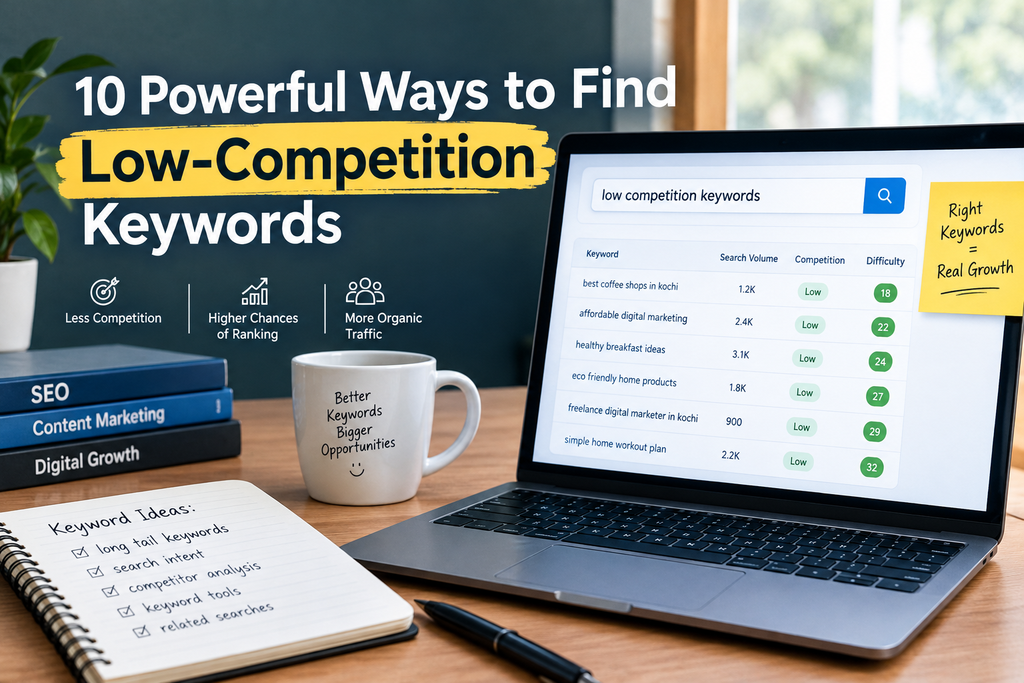
Low competition keywords are search terms you can realistically rank for, even if your website is new. They matter most when you have no big budget, no huge backlink profile, and no brand name yet.
I learned this while working on my own site. A broad term like “digital marketing” is crowded. A specific phrase like “freelance digital marketer in Kochi” speaks to a smaller, clearer audience. I’m still building that page, and I won’t claim rankings I haven’t verified. What I can share is the process I use to choose keywords, and the mistakes I try to avoid.
Table of Contents
Here are ten ways to find low competition keywords that fit your goals
1. Start With the Business, Not the Tool
Before I open any software, I ask three questions. What does the business sell? Who is the audience? Why would they search?
Good keyword research starts with those answers. A tool can give you thousands of ideas, but only you know which ones fit the business. Skip this step and you end up with easy keywords that bring the wrong visitors.
2. Search for Google Autocomplete for Long-Tail Keyword Research
It is the easiest free tool to use, and I would advise it even for novices. Just type your keyword into Google and see the suggestions it gives. Also look for the “People also ask” section and other searches that Google suggests at the bottom of the page. They are genuine questions people asked, and you can be sure that they need answers.
Long-tail keywords typically involve less competition. SEO is tough. “SEO for a new local business website” is more realistic.
3. Add Location, Audience, or a Use Case
Narrowing a keyword is one of the easiest ways to lower competition. Try adding:
- A location: “ top notch freelance digital marketer in Kochi”
- An audience: “SEO for small businesses”
- A use case: “keyword research for a new blog”
Each addition shrinks the pool of competing pages. It also makes the visitor’s intent clearer.
4. Evaluate Keyword Difficulty, but Do Not Rely on It Solely
Keyword difficulty assessment is a good first step. Tools such as Semrush assign a difficulty rating to each keyword, and the smaller the figure, the fewer competitors there are.
But remember that this is just an estimate. For me, it serves as just one indicator; it’s not set in stone. The threshold of difficulty depends on many factors, and 30 may mean too much competition for a new website, while 45 can work in a niche with poor results.
5. Study the First Page of Google
This step often tells you more than any score. Search the keyword and look closely at the top results.
Ask yourself:
- Are the top pages from large, high-authority websites?
- Or do smaller sites with thin content rank there too?
- Do the pages fully answer the search?
- Are they outdated or shallow?
If small sites rank on page one, that’s a good sign. If the results are all major brands with deep guides, move on.
6. Look for Content Gaps You Can Fill
A keyword becomes a real opportunity when you can write something more helpful than what already exists.
Read the top three results. Note what they miss. Maybe they skip examples, ignore beginners, or give outdated advice. Fill that gap. Google’s own guidance on people-first content says content should be written to help people, not just to rank. That’s exactly the mindset that works here.
7. Don’t Ignore Low Search Volume
Many people skip keywords with small volume. I don’t, as long as the intent is strong.
A keyword with 50 monthly searches from the right audience can be worth more than one with 5,000 searches from casual browsers. Low-volume keywords are also easier to win, and a cluster of them can add up over time.
8. Check Search Intent Before You Commit
This is the most common mistake I see. People pick low competition keywords because they look easy, without checking what the searcher wants.
Intent usually falls into three groups:
| Intent type | What the searcher wants | Best content |
| Informational | To learn something | Guide, tutorial, list post |
| Commercial | To compare options | Review, comparison |
| Transactional | To buy or hire | Service or product page |
Look at what Google already shows. If every result is a how-to guide, a sales page won’t rank. Match the format, then make yours better.
9. Mine Your Own Data in Google Search Console
If you have any traffic coming to your site, there is a lot of data in Google Search Console that can be mined for keywords. Navigate to Performance, then Search results, and select the Queries tab.
Keywords that yield a good number of impressions and low click-through rate or rank on the second page are a great place to start. They are already associated with your site in Google’s eyes.
10. Group Keywords by Topic and Pick a Few
Avoid creating a ten-post blog for ten similar keywords. This means that you end up with keyword cannibalization, which occurs when pages within your site compete with one another.
Instead, group related keywords by intent. Give each topic one page with one primary keyword. Start with three to five realistic targets rather than chasing dozens.
A Simple 30-Minute Plan to Find Low Competition Keywords
If you want to start today, try this:
- Minutes 1–10: Write down your goal and the questions your customers ask.
- Minutes 11–20: Use Google Autocomplete and related searches to collect long-tail ideas.
- Minutes 21–30: Check each idea’s intent and first page, then pick three to five.
That’s it. You don’t need paid tools to begin, though Google Keyword Planner and Semrush make the research faster.
Common Mistakes to Avoid
- Choosing keywords by difficulty score alone
- Ignoring search intent
- Targeting terms that are easy but irrelevant
- Writing several pages for the same keyword
- Expecting quick results
Keep in mind that results vary. A new site may need months before you see movement, and no keyword is a guaranteed win. Track your progress in Search Console and adjust as you learn.
FAQ
What are low competition keywords?
They are the keywords that have less number of powerful pages competing for them, making it easier for new or smaller websites to rank.
Should I target low competition keywords?
Yes, but only when there is a match between the search intent and your content as well as your audience. Irrelevant easy keywords won’t help you generate traffic.
What keyword difficulty should I aim for?
There isn’t any fixed value here. You should consider it a guide only to further investigate who’s ranking on the first page.
Is it possible to identify low competition keywords for free?
Yes. The keywords can be found free of cost using Google Autocomplete, Google People also ask, related searches, and Google Search Console.
How long does it take to rank low competition keywords?
It depends on the website and the topic of the keyword. It might take months rather than weeks.
Conclusion
Finding low-competition keywords is an effective way to discover SEO opportunities and improve your website’s organic visibility. By analyzing keyword difficulty, understanding search intent, researching long-tail keywords, and studying Google search results, you can create content that meets your audience’s needs.
As a freelance digital marketer in Kochi, I believe successful keyword research starts with understanding the target audience and creating genuinely useful, trustworthy content. Use reliable keyword research tools, evaluate the competition carefully, and focus on providing real value rather than simply targeting keywords with low difficulty. With consistent effort and a user-first SEO strategy, you can build website authority, attract relevant traffic, and support long-term organic growth.