
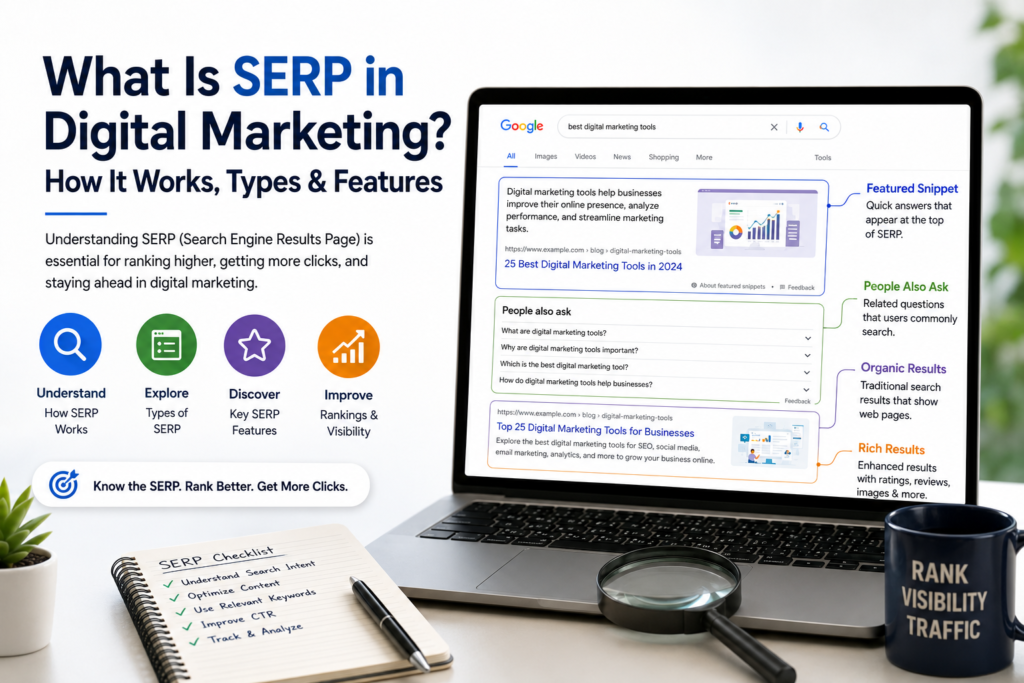
If you’ve ever obsessed over hitting the #1 organic spot only to see traffic underperform, you’ve already run into the real complexity behind SERP in digital marketing. A SERP in digital marketing isn’t just a ranked list anymore — it’s a dynamic ecosystem of snippets, ads, maps, and AI answers.
I learned this the hard way on an SEO campaign years ago. We were laser-focused on ranking #1, and nothing else. Once we shifted to optimizing content for featured snippets and People Also Ask sections too, visibility jumped, click-through rates improved, and qualified organic traffic increased — even before we reached the top organic position. That one change is why I now treat the SERP as the actual battlefield, not just the ranking as the goal.
This guide breaks down what SERP means, the types you’ll encounter, the features worth optimizing for, and the process I actually use.
What Is SERP in Digital Marketing?
SERP stands for search engine results page — the page that appears after someone runs a search. In digital marketing, understanding SERP in digital marketing means understanding everything on that page, not just the ten blue links. Google now fills that page with featured snippets, local packs, image carousels, People Also Ask boxes, and increasingly, AI-generated overviews.
The mistake I made early on — and one I still see constantly — is assuming the only goal is the #1 organic position. I overlooked SERP features entirely. Once I started optimizing for those elements too, visibility and traffic improved significantly, even on pages that never held the top organic spot.
Types of SERPs You’ll Actually Encounter
Not every search engine results page looks the same. The format Google shows depends heavily on search intent. Here are the main types worth knowing:
| SERP Type | Common Trigger | What Usually Appears |
| Informational | “how to,” “what is,” “why” | Featured snippets, People Also Ask, video results |
| Local | “near me,” city/service searches | Local pack (map + business listings), reviews |
| Transactional | “buy,” “best [product],” “price” | Shopping ads, product listings, comparison content |
| Navigational | Brand or site names | Sitelinks, knowledge panel |
Recognizing which type you’re dealing with is the first real step in optimizing for it — you can’t write toward a SERP you haven’t identified correctly.
How to Analyze a SERP Before You Write
Here’s the process I actually follow before drafting anything:
- Identify search intent first. What is the person actually trying to accomplish with this query?
- Analyze the top-ranking pages and SERP features. Look at what’s already winning — featured snippets, People Also Ask, local results — and study their format.
- Find the content gap. Look for what’s missing or under-explained in the current top results, and build content that’s more complete and genuinely more helpful.
This order matters. Skipping straight to “what do competitors rank for” without confirming intent is how you end up creating content that technically targets the keyword but doesn’t actually answer the search.
SERP Features Worth Understanding
Featured Snippets
This is the one most marketers underestimate. A featured snippet — sometimes called “position zero” — displays a direct answer above the organic results. Independent studies have consistently found featured snippets carry some of the highest click-through rates on the entire results page, often outperforming the standard #1 organic listing on visibility alone.
Winning a featured snippet can deliver higher visibility, improve click-through rates, and build authority — even when your page isn’t the top organic result. That’s exactly what played out on the campaign I mentioned earlier.
People Also Ask (PAA)
These expandable question boxes reveal related queries users are also searching for. They’re a strong signal of related search intent and a good source of subtopics to cover within your own content.
Local Pack
For location-based searches, Google often replaces standard organic listings with a map and three local business results. If you’re optimizing local content, this — not organic rank — is often the real prize.
Knowledge Panels and Image Packs
They’re usually about your brand, your entity, or a visual search, and are more difficult to optimize for directly, but structure and brand consistency will help you.
Optimizing Content for Specific SERP Types: “How-To” Example
“How-to” searches are a great example of a SERP that looks noticeably different from a standard query. These results pages often surface featured snippets and People Also Ask boxes prominently. To match that, I structure how-to content with:
- Clear, sequential step-by-step headings
- Concise, direct answers near the top of each section (ideal for snippet extraction)
- A dedicated FAQ section addressing related PAA-style questions
This structure isn’t decoration — it directly increases the odds of earning those SERP features, which is where a meaningful share of clicks now go.
Common Mistakes When Optimizing for SERPs
- Chasing rank #1 while ignoring SERP features entirely
- Writing content that matches the keyword but not the actual search intent
- Skipping competitor SERP analysis before drafting
- Ignoring “how-to” and question-based formatting opportunities
- Assuming every SERP in digital marketing looks the same
FAQs
In the digital marketing world, what is the meaning of SERP in digital marketing? A SERP in digital marketing is the page a search engine shows when it performs a search query, including organic results and other content, such as snippets and local packs.
Is ranking #1 still important if SERP features exist? Yes, but it’s no longer the only goal. Featured snippets and other SERP features can generate strong visibility and clicks even without the top organic position, so both should be part of your strategy.
How do I optimize content to appear in a featured snippet? Structure your content with clear, direct answers near the top of relevant sections, use descriptive headings, and directly address the question the searcher is likely asking — particularly for how-to and definition-style queries.
Conclusion
Understanding how Search Engine Results Pages (SERP) work is a fundamental step toward building an effective SEO strategy. As search engines continue to evolve with AI-powered features, featured snippets, local results, and rich search experiences, businesses that understand search intent and optimize for modern SERPs are better positioned to earn visibility, attract qualified traffic, and achieve sustainable growth.
This guide is based on practical SEO knowledge, continuous learning, and real-world application rather than theory alone. By analyzing SERPs before creating content, you can better understand user intent, identify ranking opportunities, and develop content that provides genuine value to your audience.
This article was written by Amalraj p s, a freelance digital marketer in Kochi, who specializes in SEO, content strategy, and performance-driven digital marketing. My approach combines hands-on experience, data-driven decision-making, and Google’s best practices to help businesses improve their online visibility and build long-term organic growth.
If you’re looking to strengthen your SEO strategy, improve your search rankings, or create content that performs in both traditional search results and AI-powered search experiences, feel free to connect. Together, we can build a sustainable digital marketing strategy that delivers measurable business results.