
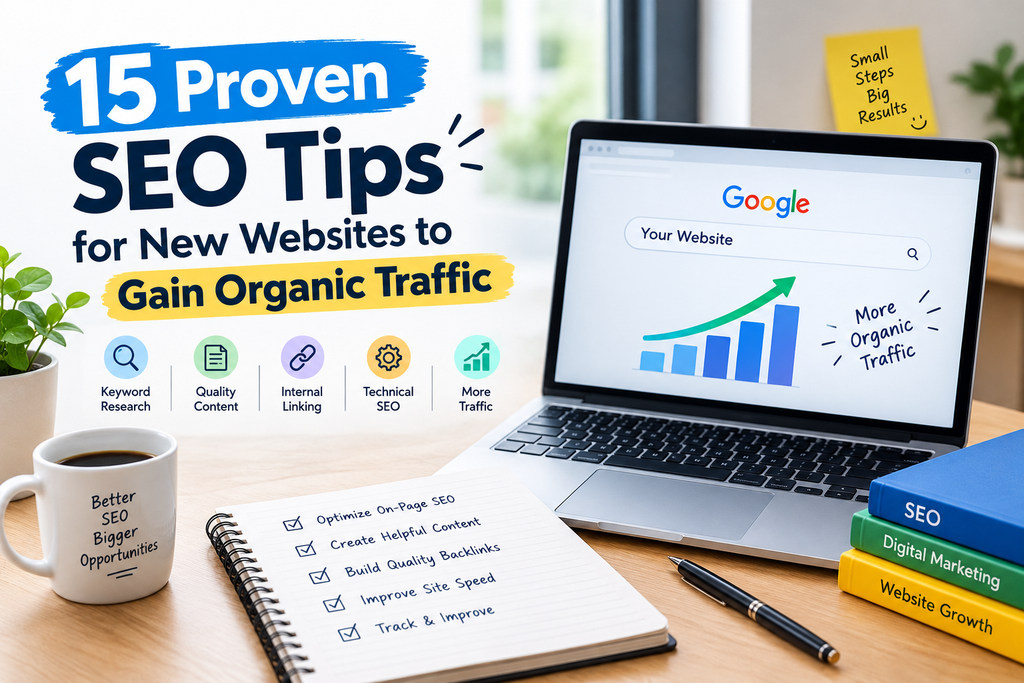
A new website starts with zero authority, zero history, and often zero visibility. That is normal. The good news is that the right SEO tips for new websites can get you discovered faster than you might expect.
I work as a freelance digital marketer, and I follow the same pattern on almost every new site: get found first, then get relevant, then get better over time. This guide walks through 15 practical SEO tips for new websites in that order. Each one is practical and beginner-friendly.
One honest note before we start: SEO takes time. Results depend on your niche, your competition, and the quality of your content. Nobody can promise a ranking date.
Table of Contents
Part 1: Get Your New Website Discovered
1. Set up Google Search Console first
I start this right away when creating a new site because this tool is free and will help me understand whether Google can crawl and index my website. Otherwise, you just don’t know.
Among the most critical SEO tips for new websites, verifying your domain in Google Search Console and confirming your homepage is indexed before publishing blog posts saves you from crawl issues later.
2. Submit your XML sitemap
A sitemap is a list of all pages of your website. By submitting it to Google Search Console, you help Google find your pages easier. Most website platforms offer an opportunity to create it in just a couple of clicks.
3. Check that your pages are indexed
If the page is not indexed, then it will not be able to rank on the first page. For checking the indexing status of important pages, you can use the URL Inspection feature on Google Search Console. If there is anything that is blocked, then make sure to solve that first.
Part 2: Choose the Right Keywords
4. Start with search intent, not search volume
Before deciding which keyword to use, search it on Google and analyze the results. Do people find tutorials, products, or local business listings? The content of your website should be exactly what the searchers need.
This is how my straightforward keyword research process works:
- Know your target audience and come up with seed keywords.
- Get related ideas using Google Keyword Planner and Autocomplete.
- Analyze the search results to understand the intent and competition.
- Prioritize relevant, less competitive keywords.
- Assign one main keyword to each page.
5. Go specific and low-competition
This is the most common mistake I see with new sites. Beginners chase broad, high-volume keywords that big, established websites already own. A new site rarely wins those early on.
Here is a typical illustration. A local plumber’s page targeting a broad term like “plumbing services” will struggle. A page built around a specific, location-based phrase has a far better chance. This is an example of the pattern, not a verified client result.
| Approach | Example keyword | Difficulty for a new site |
| Broad | plumbing services | Very high |
| Specific and local | emergency pipe repair in [your city] | Much lower |
6. Give every page one primary keyword
If two webpages try to rank for the same keyword, there is a direct competition between them. This phenomenon is known as “keyword cannibalization.” Always maintain a spreadsheet containing one web page along with one keyword target. It will take ten minutes but will save you a lot of trouble in future.
Part 3: Optimize What Is on the Page
7. Write clear title tags and meta descriptions
The title tag is your headline in the search engines. Try not to exceed 60 characters and use the main keyword early on. Write the meta description for people and limit it to 150/160 characters.
8. Use a clean heading structure
When applying on-page SEO tips for new websites, keep your heading structure clean: use one H1 per page, then H2 for main headings and H3 for sub-headings.
9. Write really helpful content
Provide answers that aid the person who asked the question. Provide full answer in simple English with examples. If you have the same type of content as someone else who is already ranking, and you don’t provide anything new, why should Google choose you over the competition?
Use process or experience to write your own response about your ideas on the subject.
10. Do not ignore internal linking
Keywords and backlinks are usually what novice users concentrate on. Internal links are links that connect pages that are related; they will help the search engine find your website and keep visitors on your website.
Whenever a new page is added, link it to at least one page that is close to the meaning or topic of the new page, and link to pages that are related to the new page from the new page. Use exact phrases instead of using a generic phrase such as “click here”, such as “keyword research checklist”.
Part 4: Fix the Technical Basics
11. Cover the basic technical checks
You do not need advanced technical knowledge on day one to implement essential technical SEO tips for new websites. Start with these:
- Make sure the site loads over HTTPS.
- Check that it works well on mobile phones.
- Fix broken links and error pages.
- Keep page speed reasonable by compressing large files.
Google’s own SEO Starter Guide explains these fundamentals clearly and is worth bookmarking.
12. Optimize your images
Make sure to compress images before uploading and name the files with a short and descriptive name. Write alternate text that is descriptive of the image. This makes it easier for people to find, and provides additional context for search engines.
Part 5: Build Trust and Measure Progress
13. Add local signals if you serve a local area
If your business is local, have the same business name and same address and phone number throughout your site. All of this is very relevant to the local keywords, and Google Business Profile is a logical next step.
14. Earn a few quality backlinks
Link building can feel overwhelming, but actionable SEO tips for new websites prioritize quality over quantity. You do not need hundreds of backlinks right away. A handful of relevant links from real directories, local partners, or useful guest content will establish initial domain trust. Avoid buying links, because shortcuts hurt more than they help.
15. Track results and keep improving
Check Search Console regularly. Watch impressions, clicks, and average position, and compare them month over month. Then update pages that are close to ranking, and refresh older posts with better information.
What Results Can You Expect?
On a local service business website I worked on, I did keyword research, on-page optimization, basic technical fixes, internal linking, and sitemap submission. Impressions started appearing within a few weeks. Organic traffic then grew gradually over the next three to six months.
As a rough guide only, a small local site might see a few thousand impressions and some hundreds of clicks per month in that window. Treat those numbers as a loose benchmark, not a promise. Competition and content quality change everything.
FAQ
How long do SEO tips for new websites take to work?
Most new sites see early signs, such as impressions in Search Console, within a few weeks. Steady traffic growth usually takes three to six months or more, depending on competition.
What is the first SEO step for a new website?
Set up Google Search Console and confirm your site is indexed. Then submit your sitemap.
How do I increase organic traffic with a brand-new site?
Target specific, low-competition keywords, publish helpful content, and build strong internal links. Then track results and improve.
Do I need backlinks right away?
Not many. Start with strong content and a clean site. Add quality backlinks gradually.
Conclusion
Growing organic traffic to a new website takes time, consistent effort, and the right SEO strategy. By following these 15 proven SEO tips, you can improve your website’s search visibility, target relevant keywords, create helpful content, and build a strong foundation for long-term growth. Focus on user experience, technical SEO, internal linking, and regularly updating your content based on performance data.
As a freelance digital marketer in Kochi, I believe successful SEO is not just about ranking higher on Google; it’s about connecting businesses with the right audience and providing genuine value. By following Google’s people-first content principles, using reliable data to guide decisions, and prioritizing users’ needs, you can build trust and strengthen your website’s online presence. Remember, sustainable SEO results come from consistent improvements rather than overnight shortcuts.